What Is AI SEO?
AI SEO is the practice of optimising your business's online presence so that artificial intelligence systems — ChatGPT, Google AI Overviews, Perplexity, Claude, and others — recommend your business when users ask relevant questions.
When someone asks ChatGPT "What is the best accounting firm in Kuala Lumpur?" or Google AI generates an overview for "plumber near me that does emergency repairs," these AI systems draw on a wide range of signals to decide which businesses to mention. AI SEO is the discipline of ensuring those signals point to your business.
Unlike traditional SEO, which focuses on ranking your website in a list of blue links, AI SEO focuses on getting your business cited, recommended, and referenced in AI-generated answers. The user may never visit a traditional search results page at all — they get their answer (and your business name) directly from the AI.
Definition
AI SEO is the process of optimising a business's digital presence — including its website, structured data, directory listings, reviews, and content — so that AI-powered search and recommendation systems accurately identify, cite, and recommend it in response to relevant user queries.
The field emerged from the observation that AI language models do not simply index and rank web pages like traditional search engines. Instead, they build internal representations of entities — businesses, people, products, and places — and use those representations to generate answers. If your business entity is weak, inconsistent, or poorly documented across the web, AI will recommend someone else.
For a beginner-friendly introduction, see our guide on AI SEO for Beginners: Everything You Need to Know.
Why AI SEO Matters for Your Business
The way people find businesses is changing. In 2025, an estimated 79% of consumers used AI tools at least once per week, and that number continues to grow. More critically, the traffic that arrives through AI recommendations converts at dramatically higher rates than traditional organic search.
The reason for this conversion difference is trust. When ChatGPT or Google AI recommends your business, the user perceives that recommendation as a vetted, authoritative endorsement. They arrive at your website pre-qualified and pre-trusting. That is fundamentally different from clicking the third blue link on a search results page.
Why It Matters Especially in Malaysia
Malaysia's digital landscape makes AI SEO particularly important. With high smartphone penetration (over 97%), a young and tech-savvy population, and growing adoption of AI assistants, Malaysian consumers are rapidly shifting toward AI-mediated search. Meanwhile, most Malaysian businesses have not yet optimised for AI search, creating a significant first-mover advantage.
Google AI Overviews are already appearing for Malaysian search queries — particularly in services, healthcare, property, and technology. Businesses that optimise now will be the ones AI recommends when the majority of consumers make the shift. For a detailed analysis, read How Google AI Overviews Are Changing Search for Malaysian Businesses.
For the latest data points, our AI SEO Statistics 2026 article covers 25 data points every business should know.
How AI Engines Decide What to Recommend
Different AI engines use different methods, but they share common principles. Understanding these helps you optimise effectively rather than guessing.
ChatGPT (OpenAI)
ChatGPT draws from two sources: its training data (a large corpus of web content, updated periodically) and, when browsing is enabled, real-time web search results via Bing. For local business recommendations, ChatGPT relies heavily on consistent entity information across multiple sources — your website, Google Business Profile, directories, review platforms, and news mentions. It favours businesses that have clear, specific, and verifiable information. Read our deep dive on How ChatGPT Recommends Local Businesses for real examples.
Google AI Overviews
Google AI Overviews appear directly at the top of search results and synthesise information from multiple web pages. Because Google already has its Knowledge Graph, Search Generative Experience uses both its existing entity understanding and real-time page content. Structured data (schema markup) is particularly impactful here — Google can directly parse your LocalBusiness, Service, and FAQ schema into AI Overview responses. Learn how to implement it in our guide on Schema Markup for AI Search.
Perplexity
Perplexity always searches the web in real time and cites its sources. This makes it the most transparent of the AI search engines — you can see exactly which pages it draws from. Perplexity values pages that directly answer questions with specific data, statistics, and clear structure. Content with headers, lists, and explicit answers performs well. Businesses with strong topical authority — multiple pages covering related subjects in depth — are cited more frequently.
Claude (Anthropic)
Claude draws primarily from its training data and is notably cautious about making specific business recommendations without high confidence. It tends to recommend businesses that have extensive, consistent, and authoritative online presences. Claude is particularly sensitive to conflicting information — if your business name, address, or services differ across sources, Claude is more likely to hedge or omit rather than recommend.
The Common Thread Across All AI Engines
- check_circle Entity consistency: Your business name, address, phone number, and services must match everywhere.
- check_circle Structured data: Schema markup helps AI parse your information accurately.
- check_circle Authoritative content: Specific, verifiable, data-backed content gets cited more.
- check_circle Third-party validation: Reviews, directory listings, and independent mentions build trust signals.
AI SEO vs Traditional SEO
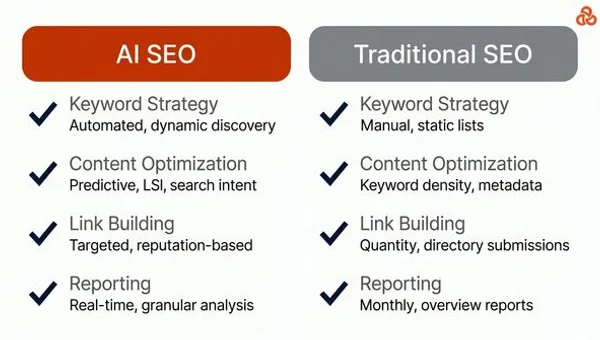
AI SEO and traditional SEO are not replacements for each other — they are complementary. Traditional SEO builds the foundation that AI SEO depends on. But there are meaningful differences in what each discipline prioritises.
| Dimension | Traditional SEO | AI SEO |
|---|---|---|
| Goal | Rank in search results | Get cited in AI answers |
| Content Focus | Keyword-targeted pages | Answer-first, entity-rich content |
| Key Metric | Rankings, organic traffic | AI citations, recommendation frequency |
| Technical Priority | Page speed, crawlability, Core Web Vitals | Schema markup, entity consistency, AI crawler access |
| Off-Site Focus | Backlinks | Reviews, directory consistency, community presence |
| Content Format | Long-form, keyword-dense | Structured, data-rich, directly quotable |
| Conversion Rate | ~3.2% average | ~14.2% average (4.4x higher) |
The most important difference is philosophical. Traditional SEO asks: "How do I get my page to rank for this keyword?" AI SEO asks: "How do I make AI confident enough in my business to recommend it?"
Confidence comes from consistency, authority, and specificity. A business with a well-optimised Google Business Profile, consistent NAP across 40 directories, genuine customer reviews, structured data on every page, and content that includes specific pricing, service areas, and verifiable claims — that business is easy for AI to recommend with confidence.
For a deeper comparison, read our full article: AI SEO vs Traditional SEO: What Is the Difference?
The Evidence: KDD 2024 and Conversion Data
One of the reasons we focus on AI SEO at AI SEO Malaysia is that the evidence base is unusually strong — stronger, in fact, than most claims made in traditional SEO.
The KDD 2024 Research Paper
The most significant evidence comes from a peer-reviewed paper presented at the ACM SIGKDD Conference on Knowledge Discovery and Data Mining in 2024. The researchers studied how specific content optimisation techniques affect visibility in AI-generated search results.
Key Findings from KDD 2024
Adding citations and statistics improved AI visibility by 22-40% across different AI models. Content that included specific, verifiable data points was cited significantly more often.
Structured data and clear formatting improved content discoverability. Pages with proper headings, schema markup, and logical organisation were more likely to be referenced in AI responses.
Domain authority still matters — but entity authority matters more. A small business with strong entity signals could outperform a larger competitor with weaker AI-specific signals.
Manipulative techniques backfired. Attempts to game AI visibility through keyword stuffing, hidden text, or artificially generated content resulted in lower visibility, not higher.
The 14.2% Conversion Rate Data
Industry data consistently shows that AI referral traffic converts at approximately 14.2%, compared to 3.2% for traditional organic search. This 4.4x difference is not surprising when you consider the mechanism: a user who receives a direct recommendation from a trusted AI assistant arrives at your business with higher intent and higher trust than someone browsing search results.
You can track this yourself using GA4. Our step-by-step guide on How to Track AI Referral Traffic in GA4 shows you exactly how to set up custom channel groups for ChatGPT, Perplexity, and other AI referral sources.
These are not theoretical numbers. They represent real business outcomes — more calls, more form submissions, more revenue — from traffic that most businesses are currently ignoring because they do not know it exists.
What Works: Proven AI SEO Strategies
Based on the KDD 2024 research and our practical experience with Malaysian businesses, these are the strategies that consistently improve AI visibility.
1. Google Business Profile Optimisation
Your Google Business Profile is the single most important lever for local AI visibility. AI engines cross-reference GBP data constantly. Every field matters — business description, categories (primary and secondary), service areas, attributes, Q&A, photos, and regular posts. A fully optimised GBP with consistent weekly updates dramatically increases your chance of being recommended. See our comprehensive guide: Google Business Profile Optimisation for AI Visibility. For professional support, explore our GBP Optimisation service.
2. Entity Consistency (NAP + Beyond)
AI builds its understanding of your business from multiple sources. If your business name, address, phone number (NAP), service descriptions, and opening hours differ across directories, AI loses confidence and skips you. Achieving consistency across 30-50 directories, your website, and your GBP is fundamental. Our Local Entity Management service handles this systematically.
3. Schema Markup
Structured data is the language AI understands natively. LocalBusiness, Service, FAQ, Organization, and Review schema markup allow AI engines to parse your information with precision rather than inference. The KDD 2024 research found that structured data was one of the highest-impact optimisations. Learn the implementation details: Schema Markup for AI Search.
4. Answer-First Content
AI models prefer content that directly answers questions with specific data. Instead of "our pricing is competitive," write "our standard air conditioning service costs RM 180-250 depending on unit type." Pricing guides, service area pages with specific details, and FAQ content that answers real customer questions are high-value content types for AI SEO. This is what our AI Citation Content service creates. For tips on optimising existing content, see AI Content Optimisation.
5. Review Velocity and Quality
Reviews are the number one off-site signal for AI recommendations. What matters most is not your total review count but your review velocity — how many genuine reviews you receive per month — and review quality — specific, detailed reviews that mention services and outcomes. AI engines weight recent reviews more heavily than old ones. Read how reviews directly affect AI: Do Google Reviews Affect AI Recommendations? Our Review & Citation Building service builds sustainable review velocity.
6. Authentic Community Presence
AI models learn from forums, social media, and community discussions. When your business (or its founder) is genuinely active in relevant communities — answering questions in Facebook Groups, contributing to subreddits, participating in local forums — AI picks up those mentions as trust signals. This must be authentic participation, not promotional spam. Learn more about our Community Presence service.
What Does Not Work
Just as important as knowing what works is knowing what to avoid. These approaches waste resources and can actively harm your AI visibility.
Keyword Stuffing for AI
Repeating "best plumber in KL" fifty times on a page does not make AI more likely to recommend you. AI language models understand semantic meaning — they know when content is written for manipulation rather than information. The KDD 2024 research explicitly found that manipulative techniques reduced visibility.
Astroturfing and Fake Reviews
Fake reviews are detectable by AI. Google's algorithms are increasingly sophisticated at identifying artificial review patterns, and the same signals that flag fake reviews for Google also make AI engines distrust your business entity. One fake review scandal can permanently damage your AI visibility.
Mass-Produced AI Content
Using AI to generate hundreds of thin, generic pages does not build authority — it dilutes it. AI engines are trained on the same models that generated that content, and they can recognise its patterns. Quality, specificity, and genuine expertise signal trustworthiness. One detailed pricing guide outperforms twenty generic blog posts.
Blocking AI Crawlers
Some businesses block AI crawlers (GPTBot, PerplexityBot, ClaudeBot, Google-Extended) in their robots.txt, thinking this protects their content. In practice, it makes you invisible. If AI cannot access your content, it cannot recommend you. Ensure your robots.txt allows AI crawlers. If your business is currently invisible, this is one of the first things to check — read Why Your Local Business Is Invisible to AI.
Ignoring Off-Site Signals
Optimising only your website while ignoring your Google Business Profile, directory listings, and review profiles is like polishing one window of a building. AI cross-references everything. Your on-site and off-site signals must be consistent and strong.
Local vs Global AI SEO
AI SEO strategies differ significantly depending on whether your business serves a local market or a global audience.
Local AI SEO
- arrow_right Google Business Profile is the primary lever
- arrow_right NAP consistency across local directories is critical
- arrow_right Reviews and review velocity drive recommendations
- arrow_right Service area pages with specific local details matter
- arrow_right LocalBusiness schema with geo-coordinates
- arrow_right Community participation in local forums and groups
Global AI SEO
- arrow_right Topical authority and content depth are primary levers
- arrow_right Backlinks and domain authority still weigh heavily
- arrow_right Original research and data generate the most citations
- arrow_right Industry press coverage and expert mentions matter
- arrow_right Organization and Article schema take priority
- arrow_right Multi-language content for international reach
For most Malaysian businesses, local AI SEO is the priority. When a user in Petaling Jaya asks ChatGPT for a recommendation, AI draws heavily on local signals — GBP data, local reviews, directory listings, and service area content. The businesses that invest in these local foundations are the ones that get recommended.
AI SEO Malaysia specialises in local AI SEO for Malaysian businesses. Our approach combines all the local levers — AI Visibility Audit, GBP Optimisation, Local Entity Management, and AI Visibility Reporting — into a systematic programme that builds your local AI presence month by month.
Getting Started with AI SEO
Whether you work with an agency or start on your own, here is a practical roadmap for improving your AI visibility.
Check Your Current AI Visibility
Start by testing how your business currently appears. Ask ChatGPT, Google AI, and Perplexity for recommendations in your category and location. Note whether you appear, how you are described, and what competitors show up instead. Our free AI visibility check does this systematically across multiple AI engines. You can also follow the DIY approach in How to Check Your Business AI Visibility.
Fix Your Google Business Profile
This is the highest-impact action for most local businesses. Ensure every field is complete and accurate: business description with keywords, correct categories, service area, attributes, regular posts, and Q&A. Our GBP optimisation guide covers every field in detail.
Ensure Entity Consistency
Audit your presence across directories, maps, and listing sites. Your business name, address, phone number, and services should be identical everywhere. Fix any inconsistencies — even small variations (like "Jalan" vs "Jln") can reduce AI confidence.
Add Schema Markup
Deploy LocalBusiness, Service, FAQ, and Organization schema on your website. This is the technical foundation that allows AI to parse your business information with precision.
Create Answer-First Content
Publish content that directly answers the questions your customers ask AI — with specific pricing, service details, and local information. Pricing guides, detailed service pages, and FAQ content are high-priority.
Build Review Velocity
Implement a systematic process for generating genuine customer reviews. Focus on recency and quality over total count. Respond to every review — positive and negative.
Track and Measure
Set up AI referral tracking in GA4, conduct monthly prompt testing, and monitor your Local AI Visibility Score. What gets measured gets improved.
Frequently Asked Questions
Is AI SEO the same as traditional SEO? expand_more
No. Traditional SEO focuses on ranking in blue-link search results. AI SEO focuses on getting your business cited and recommended in AI-generated answers from ChatGPT, Google AI Overviews, Perplexity, and Claude. Traditional SEO is still important — it feeds the signals that AI reads — but AI SEO adds new strategies around entity consistency, structured data, and answer-first content.
How long does AI SEO take to show results? expand_more
Most businesses see measurable changes within 60-90 days. AI models update their knowledge bases on different schedules — Google AI Overviews can reflect changes within weeks, while ChatGPT's training data updates less frequently. The strategies that show results fastest are Google Business Profile optimisation and schema markup deployment.
Can I do AI SEO myself or do I need an agency? expand_more
You can start with the basics yourself: optimise your Google Business Profile, add schema markup, ensure NAP consistency, and check your visibility using our free AI visibility check. However, ongoing monitoring, content strategy, and technical optimisation benefit from professional support — especially for competitive markets.
Does AI SEO work for small businesses in Malaysia? expand_more
Yes, and in many cases small local businesses benefit the most. AI recommendations for local queries often favour businesses with strong Google Business Profile signals, consistent directory listings, and genuine reviews — areas where small businesses can compete effectively without massive budgets.
What is the KDD 2024 paper on AI SEO? expand_more
The KDD 2024 paper is a peer-reviewed study from the ACM SIGKDD Conference on Knowledge Discovery and Data Mining. Researchers found that specific content optimisation techniques — including adding citations, using structured data, and incorporating statistics — improved visibility in AI-generated search results by 22-40%. This is the most rigorous academic evidence available for AI SEO strategies.
Will keyword stuffing help me rank in AI search? expand_more
No. AI models are specifically trained to recognise and penalise manipulative content. Keyword stuffing, hidden text, and other traditional SEO spam techniques are even less effective for AI search than for traditional search. AI values authoritative, well-structured, and genuinely helpful content.
How do I track AI referral traffic? expand_more
You can track AI referral traffic in GA4 by creating custom channel groups for AI sources like ChatGPT (chat.openai.com, chatgpt.com), Perplexity (perplexity.ai), and Claude (claude.ai). AI referral traffic converts at an average of 14.2% — roughly 4.4 times better than organic search traffic.
Is AI SEO only for English-language businesses? expand_more
No. AI engines operate in multiple languages, and the fundamental principles — entity consistency, structured data, authoritative content — apply regardless of language. However, AI models currently have stronger coverage of English-language content, so businesses in multilingual markets like Malaysia may benefit from having strong English and Malay content.