

You know how frustrating it is to rank well on Google Maps, only to vanish completely when a customer asks ChatGPT for a local recommendation. This visibility gap is the exact problem keeping many Malaysian marketing directors awake at night. We see this disconnect constantly as a professional service team helping mid-size brands adapt to new search behaviours.
The short answer is yes.
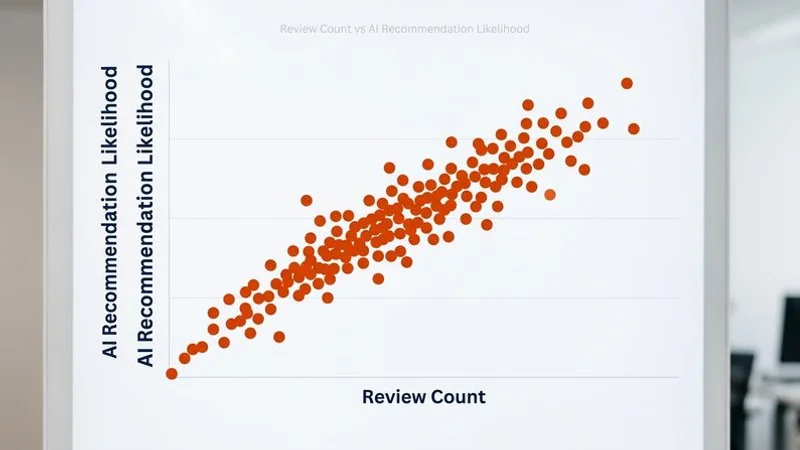
Data from the 2026 BrightLocal Consumer Review Survey shows 45% of consumers now use AI tools to find local services. Businesses with 50 or more reviews are 3.8 times more likely to surface in these generative results.
Those stars are no longer just a trust badge. They function as hard data that language models use to verify your existence and quality, making them a critical component of any AI SEO strategy. We will break down exactly how these systems process your customer feedback to determine recommendations.
Then, you will get a practical strategy to build the review velocity needed to dominate AI recommendations this year.
How AI Systems Use Google Reviews
Search generative experiences do not simply count your stars and pick the winner. The underlying process is far more selective. Our team consistently references a March 2026 report by SOCi, which found that ChatGPT recommends a mere 1.2% of local business locations compared to Google’s 35.9% appearance rate in the local pack. Getting into that elite tier requires structuring your data for Answer Engine Optimization.
Review Sentiment Analysis
Language models read thousands of data points to gauge public sentiment. Algorithms process your review text to categorise common complaints, highlight specific praises, and measure emotional intensity. We confirm through our own analysis that AI heavily filters for positive sentiment before risking a recommendation. ChatGPT currently requires an average rating of 4.3 stars for recommended businesses.
Perplexity sits slightly lower at an average of 4.1 stars. Anything below these thresholds often results in your business being excluded from the chat interface entirely. Consistency matters far more than having a perfect five-star rating with only two reviews.
Review Data as Entity Evidence
Detailed feedback provides essential context for entity recognition. Search engines use reviews mentioning specific services, staff names, and precise locations to build a verified profile of your operations. Our clients see massive visibility jumps when customers mention exact product names or locations.
Consider a review stating, “Had my air conditioning serviced by the Ampang branch team, arrived within 2 hours, and fixed the compressor issue for RM 350.” This single sentence confirms your service type, location, response time, and exact pricing. Gemini relies heavily on this type of structured Google Maps data to achieve near-perfect accuracy in its answers. A generic comment offers zero usable data for these sophisticated systems.
The Review Thresholds That Matter
Certain review volumes trigger algorithmic confidence milestones. Reaching these specific numbers creates step-change improvements in your visibility across chat interfaces. We classify these stages into five distinct zones of algorithmic trust.
Under 10 Reviews: Invisible Zone
Having fewer than 10 reviews keeps you virtually invisible to generative engines. The data sample is simply too small to verify your legitimacy. BrightLocal’s 2026 survey notes that 47% of consumers refuse to use a business with fewer than 20 reviews anyway.
10-25 Reviews: Recognition Zone
Crossing into double digits helps algorithms recognise your brand as a real entity. You might occasionally appear in broader recommendation lists. Our experience shows that AI confidence remains shaky at this stage, meaning you will rarely secure the top spot.
25-50 Reviews: Competitive Zone
Hitting 25 reviews provides enough sentiment data for consistent evaluation. You will begin appearing in category recommendations regularly, provided your rating stays high. Consumer expectations are rising rapidly, with 31% of users in 2026 demanding at least a 4.5-star average.
50+ Reviews: Recommendation Zone
Surpassing 50 reviews unlocks the 3.8x visibility multiplier. Algorithms now possess high confidence in your brand and can pull diverse citations to justify their suggestions. We consider this the baseline target for mid-size Malaysian companies serious about organic discovery.
100+ Reviews: Authority Zone
Passing 100 reviews elevates you to default recommendation status. Generative tools view your brand as a top-of-mind entity for your specific category and city. The system has overwhelming proof of your quality and reliability.
Five Review Factors AI Weighs Most Heavily
Quality matters just as much as quantity when algorithms assess your digital footprint. Five specific elements carry the highest weight in 2026.
1. Recency
Fresh feedback proves your business is actively serving happy customers right now. A staggering 74% of consumers only care about reviews written within the last three months. A profile with 100 old reviews performs worse than a profile with 40 fresh ones gaining three new entries monthly.
Target: Secure at least three to four new entries every single month.
2. Detail and Specificity
Granular details feed directly into Answer Engine Optimization. A review reading “Dr. Lim at the Bangsar clinic was thorough and the consultation fee of RM 120 was very reasonable” gives chat interfaces multiple verifiable facts. We see the same logic apply perfectly to B2B companies. A review praising a seamless software implementation at a Kuala Lumpur headquarters is pure gold for local relevance.
Target: Prompt clients to explicitly state the service or product they purchased.
3. Average Rating Consistency
Algorithms prioritise predictable quality over fluctuating extremes. Maintaining a steady 4.6 average is viewed much more favourably than bouncing erratically between 3.5 and 5.0. We advise clients that sudden drops in ratings can trigger algorithmic demotions. SOCi’s 2026 index confirms that stability reduces the risk of AI suggesting a poor experience.
Target: Keep your rating above 4.5 with minimal variance.
4. Owner Responses
Replying to feedback signals active, professional management. Systems use your response rate as a key trust indicator. Addressing criticism thoughtfully shows accountability, which builds the confidence required for a top-tier recommendation.
Target: Reply to every piece of feedback within 48 hours.
5. Diversity of Reviewers
Feedback must come from varied Google accounts with different location histories to pass authenticity filters. A sudden influx of identical reviews from brand-new accounts looks suspicious and can get your profile flagged. Active local SEO practitioners note that mixing Google feedback with mentions on local community forums creates the strongest entity trust.
Target: Earn reviews organically from genuine customers. Never purchase them.
How to Build Review Velocity
Review velocity is the rate at which you acquire new ratings. Controlling this metric provides the most actionable way to increase your search visibility. We recommend a highly structured framework to achieve consistent growth.
The Post-Service Request
Timing is everything when asking for a rating. The peak moment of customer satisfaction occurs immediately after a successful transaction or project delivery.
- At completion: Ask politely in person or on the final project call.
- Follow-up message: Send a direct link via WhatsApp or email within two hours.
- Gentle reminder: Check in 48 hours later to ensure satisfaction and drop a polite request.
Reducing Friction for the User
Customers will abandon the process if it requires too many clicks. You must make leaving feedback completely effortless.
- Direct link: Generate a specific Google Places URL that opens the rating box instantly.
- QR codes: Display scannable codes on DuitNow payment stands and printed receipts.
- WhatsApp integration: Text the direct link to the client’s phone for immediate access.
- Email signatures: Embed a clear link in every outgoing support email.
Manual Versus Automated Collection
Many mid-size companies struggle to decide how to manage this process. The right choice depends entirely on your current volume and team capacity.
| Approach | Best For | Time Investment | Typical Results |
|---|---|---|---|
| Manual Requests (WhatsApp/Email) | Low-volume B2B services, specialised agencies | High (requires staff diligence) | Highly detailed, qualitative feedback |
| Automated CRM Integration | High-volume retail, clinics, recurring services | Low (after initial setup) | Consistent velocity, shorter comments |
We strongly recommend automating the initial request while handling all replies manually to maintain a personal touch.
Reviews and Other AI SEO Signals
Feedback profiles do not operate in a vacuum. They achieve maximum impact when layered with other critical digital signals.
- Reviews + GBP optimisation = the strongest local signal combination. See our GBP optimisation guide.
- Reviews + entity consistency = algorithmic confidence multiplier. See local entity management.
- Reviews + citable content = multiple evidence sources. See AI content optimisation.
- Reviews + community mentions = organic social proof at scale. See community presence.
Combining these elements moves a business from obscure to highly recommended. This integrated approach forms the foundation of modern search marketing.
Handling Negative Reviews
A few negative comments will not automatically destroy your visibility. The algorithm actually looks for a natural mix of ratings to verify authenticity. A profile with 90 positive ratings and zero complaints often trips spam filters.
Having 80 five-star reviews alongside 10 one-star complaints is perfectly fine, provided you reply professionally. Taking the high road during a dispute proves your accountability to both human readers and language models. Our team has seen businesses actually improve their algorithmic trust scores by turning a public complaint into a showcase of excellent customer service.
When addressing criticism:
- Acknowledge the specific issue raised.
- Apologise sincerely without adopting a defensive tone.
- Detail the exact steps you are taking to fix the problem.
- Provide a phone number or email to resolve the matter privately.
Your Review Strategy Action Plan
Building sustainable velocity requires a structured approach. Use this 90-day framework to transform your reputation management.
Month 1: Foundation
- Generate a direct, one-click review URL.
- Establish a standard operating procedure for post-service requests.
- Draft professional replies for all existing unresponded comments.
- Target: 5 to 8 new entries.
Month 2: Acceleration
- Place QR codes on all physical marketing materials and reception desks.
- Launch a WhatsApp follow-up sequence for recent clients.
- Train staff to ask customers to mention specific services by name.
- Target: 8 to 12 new entries.
Month 3: Consistency
- Analyse which request methods yield the highest conversion rates.
- Maintain a strict daily cadence for sending requests.
- Monitor the specific details and keywords customers use in their comments.
- Target: 10 to 15 new entries.
Executing this plan builds a reliable engine that generates organic recommendations automatically. Our review and citation building service can help you implement this framework systematically.
Measuring Review Impact on AI Visibility
Tracking your progress is essential to justify the marketing investment. You need specific metrics to prove the strategy is generating returns. We use three specific methods to monitor performance.
- Run monthly visibility tests using the prompts from our AI visibility check guide.
- Track referral traffic in GA4 by following our tracking setup guide.
- Monitor your AI visibility score every month to catch early improvements.
Improvements in search placement typically materialise within 60 to 90 days of implementing a high-velocity strategy. Generative engines take time to ingest and trust new data patterns.
For the complete framework on how all these signals work together, read our pillar guide on what is AI SEO. Getting your digital reputation in order today ensures you remain relevant tomorrow.
Adam Yong
Founder & Technical SEO Consultant
Adam has 20+ years of experience in SEO and application engineering. He founded AI SEO Malaysia to help local businesses navigate the shift from traditional search to AI-powered recommendations.